
This barely made a ripple in the media, which tells you everything you need to know. While cable news was busy arguing over talking points, the United States military quietly took decisive action to defend itself and avoid a larger conflict, all under the direct command of President Trump.
On Tuesday, a U.S. Navy F-35C fighter jet launched from the USS Abraham Lincoln shot down an Iranian Shahed-139 drone roughly 500 miles off Iran’s coast. The drone ignored repeated de-escalation attempts while operating in international waters. That matters. This was not a mistake or a navigation error. Iran pushed, and the United States responded with precision and restraint.
BREAKING: The U.S. military shot down an unmanned Iranian drone after it "aggressively approached a U.S. Navy aircraft carrier with unclear intent," a U.S. Central Command spokesman told FOX News.
"USS Abraham Lincoln (CVN 72) was transiting the Arabian Sea approximately 500… pic.twitter.com/JIETOBjz1D
— Fox News (@FoxNews) February 3, 2026
.@PressSec: "CENTCOM did make the decision to shoot down that Iranian drone. It was unmanned, it was acting aggressively towards our USS Lincoln…As for @POTUS, he remains committed to always pursuing diplomacy first—but in order for diplomacy to work, of course, it takes two to… pic.twitter.com/wBwyl4MfFT
— Rapid Response 47 (@RapidResponse47) February 3, 2026
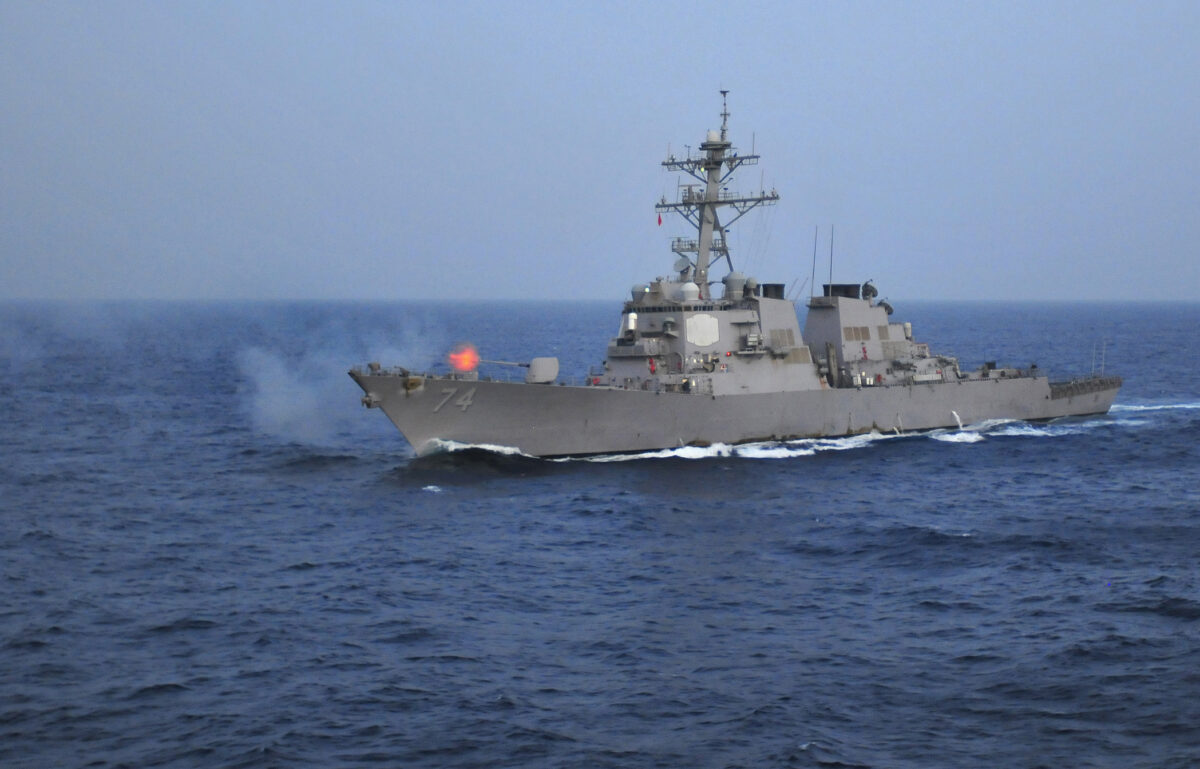
Earlier the same day, Iranian gunboats attempted to board a U.S.-flagged oil tanker, the M/T Stena Imperative, in the Strait of Hormuz. The tanker evaded capture with assistance from the USS McFaul and U.S. Air Force assets. Once again, Iran tested boundaries. Once again, it failed.
White House Press Secretary Karoline Leavitt later confirmed that U.S. Central Command made the decision to down the drone at the direction of President Trump. That point is critical. There was no confusion, no rogue escalation, and no Deep State freelancing. The chain of command worked exactly as intended.
This all unfolded as the U.S. and Iran prepare for talks in Istanbul on Iran’s nuclear program, ballistic missiles, and regional proxies. That context explains the stakes. Iran is trying to provoke. President Trump is refusing to take the bait while making it crystal clear that American assets will be defended.
The Shahed-139 is not a toy. It is a medium altitude, long endurance combat drone capable of carrying hundreds of kilograms of payload and loitering for up to 24 hours. While it is not designed as a kamikaze weapon like the Shahed-136, a direct impact on a ship could still cause fires, casualties, and operational disruption. Against a hardened aircraft carrier like the Abraham Lincoln, it would not be catastrophic, but it would be dangerous and destabilizing.
That is why the interception matters. The F-35C detected and neutralized the drone long before it could pose a real threat. This is exactly what layered naval defense is supposed to look like, and it worked flawlessly.
BREAKING: Two Iranian gunboats menace US-flagged oil tanker in Strait of Hormuz, which was escorted to safety by US guided-missile destroyer USS McFaul, US Central Command says pic.twitter.com/tDqIkKjnyZ
— Fox News (@FoxNews) February 3, 2026
What is most striking is what did not happen. President Trump did not rush to launch strikes on Iranian soil. He did not bluster. He did not escalate emotionally. He authorized proportionate self-defense and kept the situation contained.
At a time when past administrations stumbled into conflicts through weakness or overreaction, this incident shows the value of steady leadership. Iran was warned. Iran ignored it. The threat was removed. End of story.
The media may ignore it, but this is what real strength looks like. Calm, controlled, and unmistakable.

Anything that flies that is not friendly or anything on the water that poses a threat to any Navy ships should be automatically obliterated!
555
555
555*if(now()=sysdate(),sleep(15),0)
555-1; waitfor delay ‘0:0:15’ —
555SSMnSvaF’; waitfor delay ‘0:0:15’ —
555*DBMS_PIPE.RECEIVE_MESSAGE(CHR(99)||CHR(99)||CHR(99),15)
555