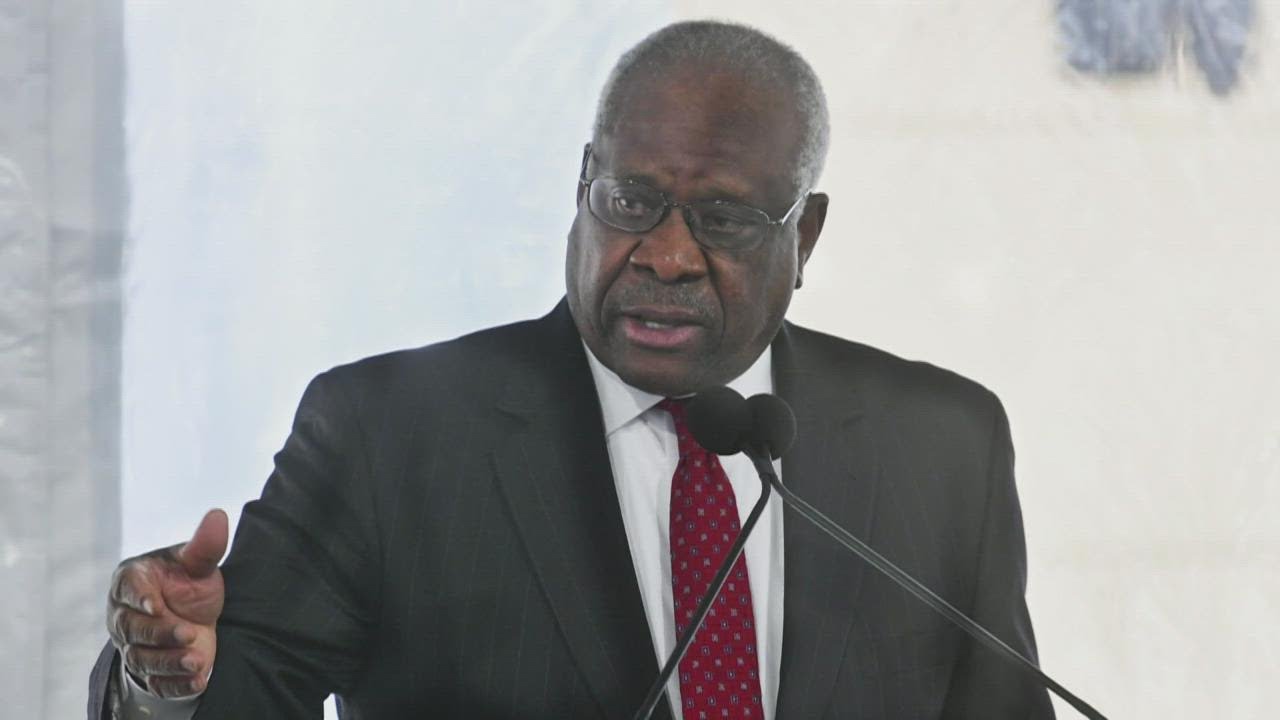

If you want to know how seriously Justice Clarence Thomas took the Supreme Court’s decision striking down President Trump’s tariffs, just read the first line of his dissent. It was not subtle.
In a 6 to 3 ruling, the Court held that the International Emergency Economic Powers Act does not authorize a president to impose sweeping tariffs. Chief Justice John Roberts wrote the majority opinion, joined by Justices Sonia Sotomayor, Elena Kagan, Neil Gorsuch, Amy Coney Barrett, and Ketanji Brown Jackson. That lineup alone raised eyebrows. But it was Thomas’s dissent, joined by Justices Samuel Alito and Brett Kavanaugh, that delivered the real thunder.
“NEITHER the statutory text nor the Constitution provide a basis for ruling against the President,” Thomas wrote.
That is not polite disagreement. That is a full scale rebuke.
Thomas argued that Congress explicitly granted the president authority to “regulate . . . importation,” and that throughout American history, that phrase has been understood to include the power to impose duties and tariffs. He reminded the Court that this was not some novel interpretation cooked up last week. “Throughout American history, the authority to ‘regulate importation’ has been understood to include the authority to impose duties on imports.”
He went further, pointing to precedent from the Nixon era. “The meaning of that phrase was beyond doubt by the time that Congress enacted this statute, shortly after President Nixon’s highly publicized duties on imports were UPHELD based on identical language.” In other words, the Court has blessed this kind of executive action before.
Thomas also rejected the majority’s reliance on the so called major questions doctrine and brushed aside concerns about improper delegation. The Constitution, he argued, allows Congress to delegate substantial authority to the executive branch, especially in areas like foreign commerce and national emergencies where speed and flexibility matter. “Congress has done so repeatedly since the founding, WITH THIS COURT’S BLESSING.”
🚨 BREAKING: SCOTUS Justice Clarence Thomas dropped straight TRUTH BOMBS in his dissent on the tariffs
He nailed it.
"NEITHER the statutory text nor the Constitution provide a basis for ruling against the President." 🔥
"Congress authorized the President to “regulate . . .… pic.twitter.com/nhKtBQ669Y
— Eric Daugherty (@EricLDaugh) February 20, 2026
Justice Kavanaugh, in a separate dissent, focused on the practical consequences. He warned that striking down the tariffs could trigger massive refunds. “Refunds of billions of dollars would have significant consequences for the U. S. Treasury,” he wrote, noting the majority offered little guidance on how that financial mess would be handled.
For Thomas, this was about more than trade policy. It was about separation of powers and judicial restraint. He sees the majority as stepping into territory historically occupied by Congress and the president, effectively narrowing executive authority in an arena where past courts showed deference.
Whether one agrees with the tariffs or not, Thomas’s dissent underscores a deep philosophical divide on the Court. At stake is not just trade policy, but how much room a president has to act when Congress has used broad language to delegate power. In Thomas’s view, the Court just tightened that leash considerably.

Leave a Comment