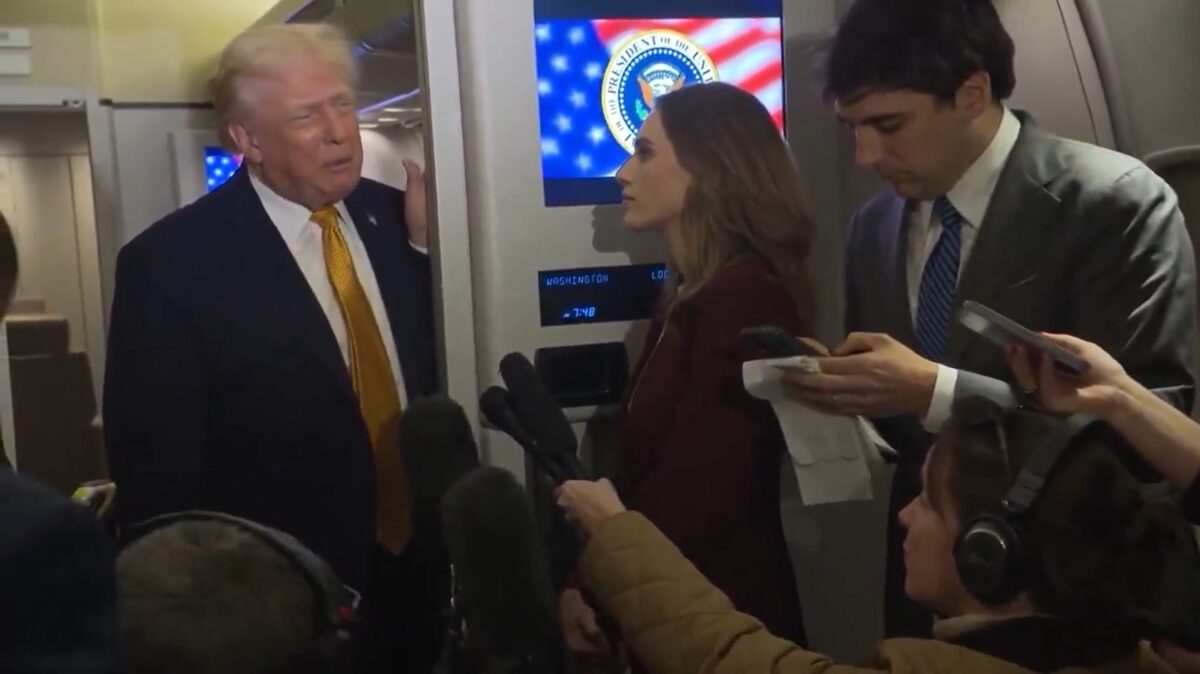

President Trump made it clear this weekend that the era of polite lectures and empty diplomacy on drug trafficking is over, and Colombian President Gustavo Petro is officially on notice. Speaking to reporters aboard Air Force One, President Trump left the door wide open to U.S. military operations inside Colombia if its leftist leadership continues to allow cocaine production and trafficking to flourish.
Petro, who has spent the last year picking public fights with President Trump, immediately panicked after Saturday’s successful U.S. operation that captured Venezuelan dictator Nicolás Maduro. He rushed troops to the border and called for United Nations intervention, a predictable move from a man who prefers press conferences to policing his own territory.
Petro’s rhetoric has grown increasingly unhinged. He has labeled the United States a “colonial” rogue state and even falsely accused President Trump of ties to Jeffrey Epstein. In October, while addressing the UN General Assembly, Petro went so far as to urge U.S. soldiers to disobey Trump’s orders if they believed them to be “inhumane.” President Trump responded appropriately by revoking Petro’s U.S. visa, a long overdue reminder that there are consequences for that kind of nonsense.
Trump’s response to Petro’s latest outburst was blunt and unmistakable. “Colombia is very sick, too. Run by a sick man who likes making cocaine and selling it to the United States. And he’s not going to be doing it very long,” Trump said. When asked directly whether future U.S. operations inside Colombia were possible, Trump did not dodge. “Sounds good to me,” he replied.
https://twitter.com/InformaCosmos/status/2008042662621016295
The history backs up Trump’s frustration. Colombia’s drug trafficking problem is not new or misunderstood. It dates back to the 1970s and exploded in the 1980s with cocaine cartels in Medellín and Cali flooding the United States with narcotics. Guerrilla groups like the Revolutionary Armed Forces of Colombia, formed as the military wing of the Colombian Communist Party, quickly became major players in the drug trade.
While FARC’s power has declined, the National Liberation Army remains deeply embedded in narcotics trafficking. The ELN operates with the blessing of Venezuela’s regime, enjoying sanctuary, training camps, and freedom of movement across at least a dozen Venezuelan states. In return, the group props up the Maduro regime, controls border crossings, and profits from illegal gold and coltan mining, with estimates suggesting up to 70 percent of its income now comes from Venezuelan operations.
The United States has designated the ELN a terrorist organization and has increasingly treated it that way. Under President Trump’s leadership, U.S. forces have conducted targeted strikes against drug traffickers and their infrastructure. That includes an October 17, 2025, missile strike on an ELN vessel off Colombia’s Pacific coast and a December 31, 2025, strike on a cocaine processing facility in Venezuela reportedly run by the group.
Petro can call the UN all he wants. He can posture and complain about sovereignty. But President Trump has made his position clear. If Colombia continues to export poison into American communities while shielding terrorists and traffickers, the United States will act. Great powers protect their people, and under President Trump, that is exactly what America is doing.
FAFO Petro!