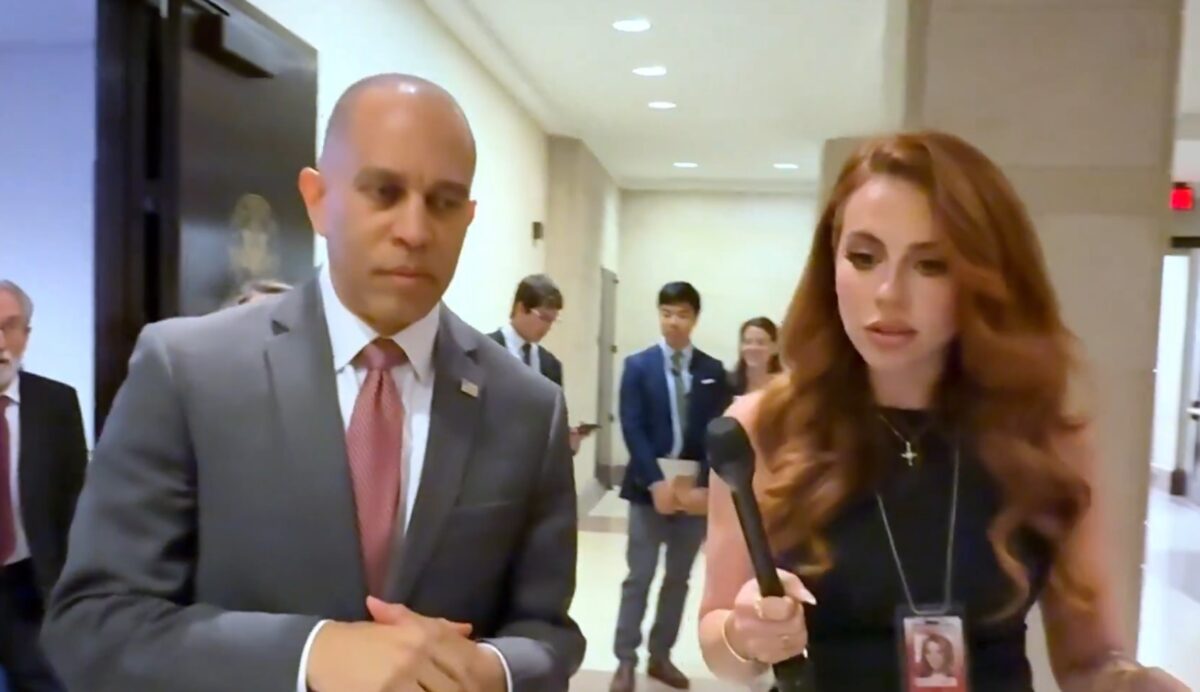

House Minority Leader Hakeem Jeffries gave a remarkably dismissive response this week when confronted about questions surrounding Rep. Ilhan Omar’s dramatic financial disclosure revisions, and the exchange is likely to raise even more eyebrows than it settled.
A reporter asked Jeffries directly whether Omar’s reported net worth plunging from as high as $30 million to under $100,000 in a matter of days, followed by the dissolution of a California winery tied to family assets, should trigger a House Ethics investigation. That is not exactly a routine bookkeeping footnote.
Jeffries brushed it aside.
According to the exchange, he said the matter had “not been brought to my attention,” then pivoted to a familiar defense line, claiming Omar is “constantly under attack by right-wing conspiracy theorists.”
https://twitter.com/RealLindellTV/status/2047353938987647217
That answer may satisfy partisan loyalists, but it does little for anyone interested in transparency.
Here is why the issue is drawing scrutiny. Omar’s 2024 financial disclosure forms reportedly listed family assets valued between $6 million and $30 million, an eye-popping jump from previous years. Much of that wealth was tied to eStCru LLC, a winery in Santa Rosa, California, reportedly co-owned by Omar’s husband, Tim Mynett.
Then things became interesting.
After public questions were raised, the disclosures were amended. Omar’s team reportedly blamed an “accounting error,” saying liabilities had not been properly included. The revised filing reduced her reported net worth to roughly $90,000 to $100,000.
That is not a small typo. That is not accidentally putting salt instead of sugar in the recipe. That is the kind of correction that tends to invite serious questions.
Soon after, the winery LLC was reportedly dissolved.
Again, maybe there is a clean explanation. Maybe there is not. But when multimillion-dollar disclosures collapse overnight and associated business entities quietly disappear, people are going to ask questions. That is how oversight is supposed to work.
Omar herself did not help matters. When confronted by the same reporter, she reportedly called the questioner “stupid” and said, “I don’t have to tell you jack sh-t!”
https://twitter.com/RealLindellTV/status/2046686783052947826
That is one approach to public accountability. Not a wise one, but certainly an approach.
Republican House Majority Whip Tom Emmer blasted the revisions, calling them “incompetence at best and a cover-up at worst.” He also said investigations are ongoing in House committees.
Meanwhile, state-level scrutiny in Minnesota reportedly continues regarding Omar’s alleged connections to the Feeding Our Future scandal, the massive fraud case involving stolen federal meal funds during the COVID era.
Now, to be clear, allegations are not proof. Errors on disclosure forms can happen. Businesses close every day. But public officials are held to a higher standard precisely because they wield public trust.
Jeffries had an opportunity to say the matter should be reviewed fairly and transparently. Instead, he defaulted to the tired script that every uncomfortable question is a conspiracy theory.
Voters are noticing that pattern. Increasingly, they are tired of it.
If nothing improper occurred, then an honest review would clear the air. If something did occur, the public deserves answers. Either way, dismissing legitimate questions is not leadership. It is damage control.

Jeffries is a total moron! He needs to find a REAL job instead of leeching off the public! How the hell did he ever get elected?