
A key election security proposal backed by President Trump suffered another setback in the Senate on Thursday after four Republican senators joined Democrats to vote against adding SAVE Act provisions to a major immigration enforcement funding package.
The amendment, introduced by Sen. Lindsey Graham of South Carolina, sought to incorporate elements of the Safeguard American Voter Eligibility (SAVE) Act into a nearly $70 billion budget reconciliation bill designed to provide funding for Immigration and Customs Enforcement (ICE) and the U.S. Border Patrol.
Among the provisions included in the amendment were requirements for proof of U.S. citizenship when registering to vote, voter identification measures, and additional election security safeguards that Republicans have argued are necessary to strengthen confidence in federal elections.
Despite support from most Senate Republicans, the amendment failed to advance after falling short of the 60 votes needed to overcome procedural hurdles. Every Democrat opposed the measure, and four Republicans crossed party lines to vote against it.
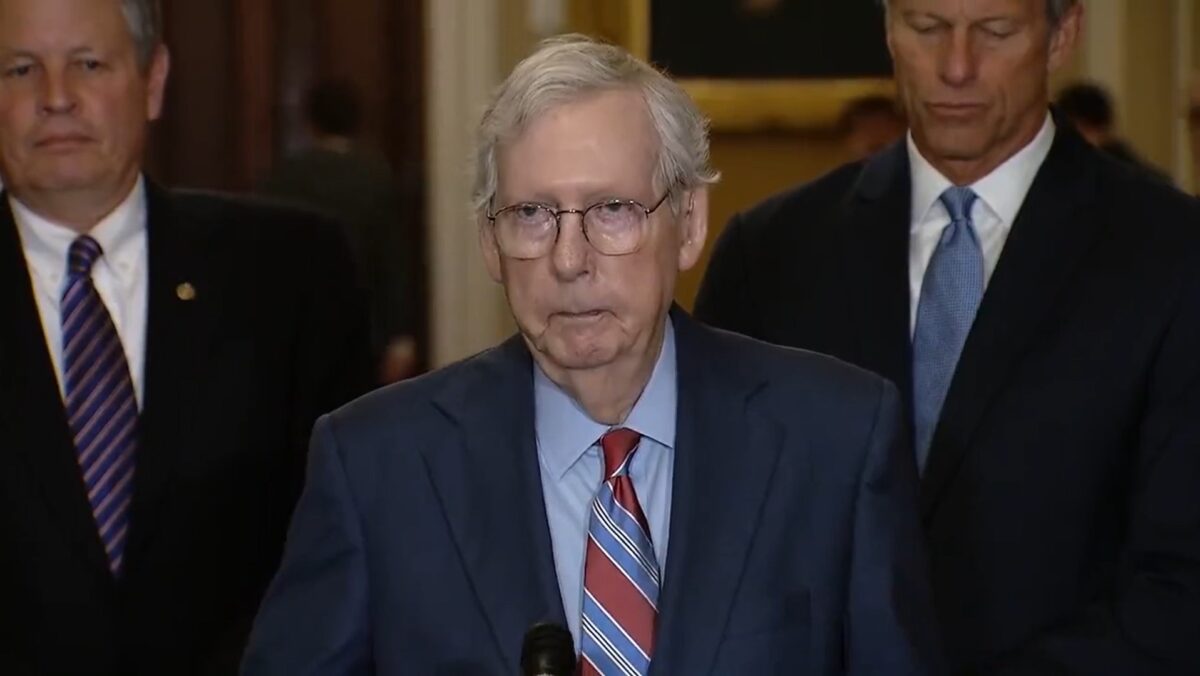
The four GOP senators were Thom Tillis of North Carolina, Lisa Murkowski of Alaska, Susan Collins of Maine, and former Senate Republican Leader Mitch McConnell of Kentucky.
https://twitter.com/PollTracker2024/status/2062671211239190860
The vote marked the second time in recent months that the same group of Republicans has opposed efforts to attach SAVE Act language to legislation moving through the reconciliation process. In April, the quartet also voted against including similar provisions during a vote-a-rama tied to a Senate budget resolution.
While Collins and Murkowski have frequently broken with Republican leadership on various issues, Tillis and McConnell have emphasized concerns about Senate procedure and the proper use of the reconciliation process.
The dispute centers largely on the unique rules governing budget reconciliation. Unlike most legislation, reconciliation bills can move through the Senate with a simple majority vote and are protected from filibusters. This allows legislation affecting federal spending, revenues, or debt levels to pass with 51 votes rather than the usual 60-vote threshold.
Supporters of Graham’s amendment viewed reconciliation as a potential path forward for election integrity measures that have struggled to gain traction under normal Senate procedures. By attaching SAVE Act provisions to a larger funding package, Republicans hoped to bypass Democratic opposition and move the legislation to President Trump’s desk with a simple majority.
The House has already passed versions of the SAVE Act with overwhelming Republican support, but Senate Democrats have remained united against the proposal, making passage through regular order difficult.
President Trump has repeatedly urged Congress to prioritize the legislation, arguing that requiring proof of citizenship for voter registration is a commonsense safeguard. He has also encouraged Senate Republicans to attach the measure to must-pass legislation whenever possible.
Thursday’s vote illustrates the continuing challenge facing Republican leaders as they attempt to advance election-related reforms in a narrowly divided Senate. While supporters insist the SAVE Act remains a top priority, the latest defeat demonstrates that internal Republican divisions, combined with unanimous Democratic opposition, continue to stand in the way.
For now, the legislation remains stalled, leaving supporters searching for another legislative vehicle that could potentially carry the measure forward in the months ahead.

Leave a Comment