
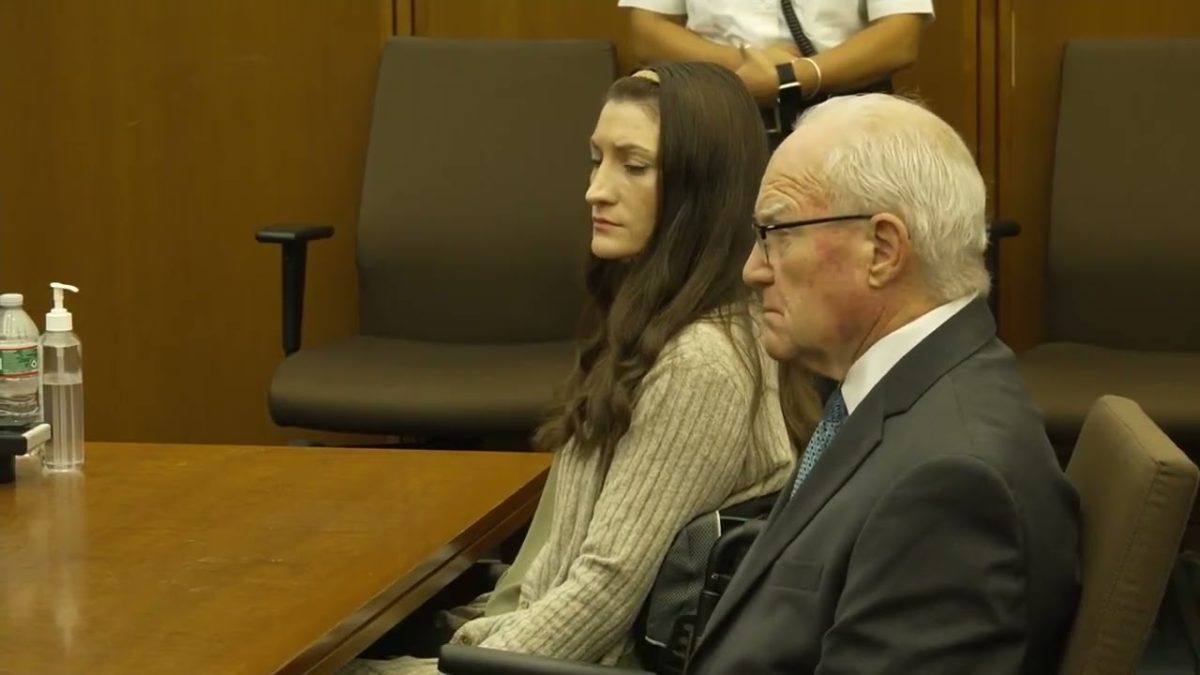

The jury deciding the fate of Lindsay Clancy remained deadlocked for a second consecutive day Wednesday, raising the increasingly real possibility that one of Massachusetts’ most disturbing murder cases could end, at least for now, with a mistrial.
Shortly before 3 p.m. on the fifth day of deliberations, jurors informed Plymouth Superior Court Judge William Sullivan that they still could not reach a unanimous verdict.
Sullivan responded by issuing what is known in Massachusetts as a Tuey-Rodriguez charge, sometimes called a “dynamite” instruction. The procedure is designed to encourage a deadlocked jury to take another serious look at the evidence and each other’s positions before concluding that agreement is impossible.
The instruction essentially reminds jurors that another jury would be selected in the same manner, would hear the same case and should not necessarily be expected to be more capable of resolving it. At the same time, jurors are instructed not to surrender sincerely held convictions simply for the sake of reaching a verdict.
Sullivan then sent the panel back to deliberate.
The development came one day after jurors first reported being unable to reach unanimity. On Tuesday morning, they told Sullivan that after many hours of discussion they were “unable to come to a unanimous decision.”
The judge initially declined to declare a mistrial, pointing to the enormous amount of evidence involved in the roughly six-week trial. More than 80 witnesses testified and jurors received more than 300 exhibits.
In other words, this was never going to be a case where 12 people walked into a room, ordered lunch and emerged 45 minutes later with a verdict.
The stakes could hardly be higher.
Clancy, 36, has admitted killing her three young children, Cora, 5, Dawson, 3, and Callan, 8 months, inside the family’s Duxbury home on January 24, 2023. The children were strangled with exercise bands while Clancy’s husband was away from the house.
Clancy subsequently attempted suicide by cutting herself and jumping from a second-story window. She survived but was left paralyzed from the waist down.
The central question for jurors is therefore not whether Clancy caused the deaths. Her defense centers on whether she was criminally responsible when she committed the killings.
Clancy has pleaded not guilty to three counts of first-degree murder and invoked a lack-of-criminal-responsibility defense, commonly described as an insanity defense. Her attorneys have pointed to postpartum psychosis and other mental health issues.
Prosecution forensic psychologist Dr. Kirk Heilbrun, however, testified that Clancy was criminally responsible. He concluded that she understood the wrongfulness of what she was doing and retained the capacity to follow the law.
Heilbrun also questioned aspects of Clancy’s reported auditory hallucination. Clancy has described hearing a male voice that instructed her to kill her children so she could then kill herself. Heilbrun characterized the reported timing of that voice as unusual because she said it occurred only during the killings.
Jurors have several possible outcomes before them, including first-degree murder, second-degree murder, manslaughter, not guilty, or not guilty by reason of lack of criminal responsibility.
If the jury again tells Sullivan that agreement is impossible, the judge could declare a mistrial. Prosecutors would then have the option of trying Clancy again before another jury, negotiating a plea agreement or declining to proceed.
Defense attorney Kevin Reddington has already said he expects prosecutors would pursue another trial.
After days of deliberations, two deadlock notices and now a special judicial instruction, the pressure inside that jury room must be extraordinary. But given that three children lost their lives, taking the time necessary to carefully determine criminal responsibility is not a flaw in the justice system.
It is exactly what the jury was selected to do.


Leave a Comment