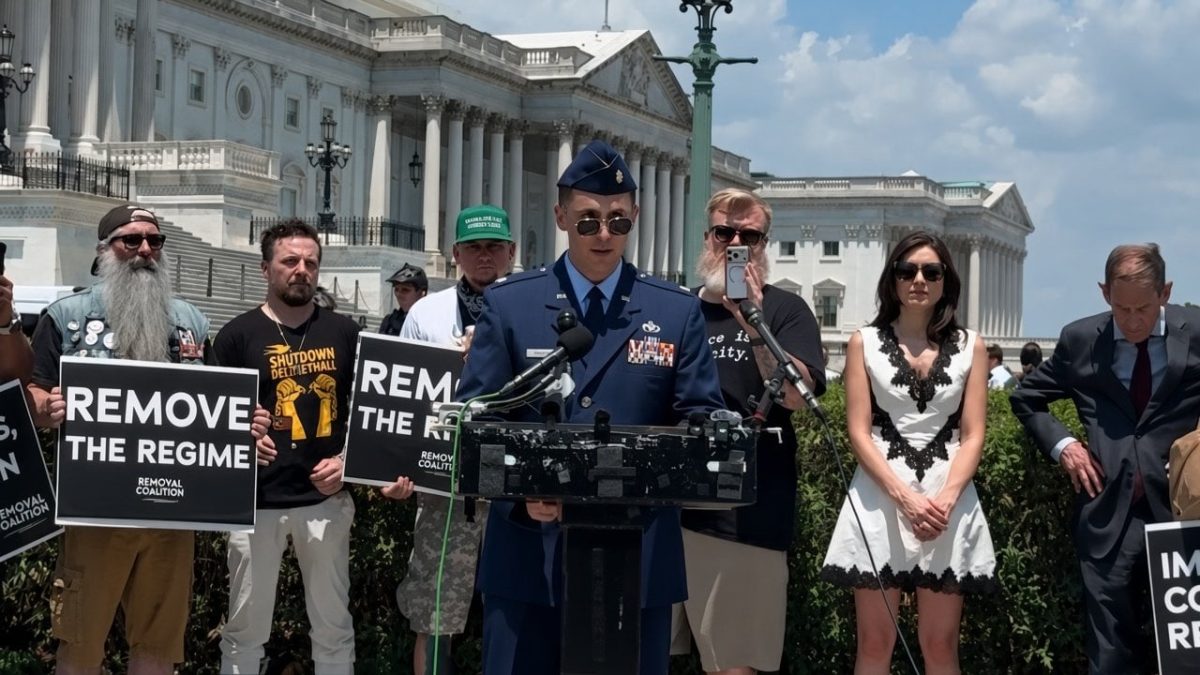

An active-duty Air Force major who repeatedly and publicly demanded President Trump’s impeachment while wearing his uniform is now learning that military service comes with rules that are considerably stricter than the average cable-news green room.
Maj. Jason Watson has been charged with 10 alleged violations of the Uniform Code of Military Justice after a series of highly public political demonstrations and statements against President Trump.
According to charging documents, Watson faces three alleged violations of Article 88 for contemptuous remarks about President Trump, five alleged Article 92 violations involving disobeying orders, and two alleged Article 133 violations for conduct unbecoming an officer. The Air Force confirmed that Watson remains in pretrial confinement while the military justice process moves forward.
🚨 UPDATE: Active Duty Air Force Major Jason Watson faces MASS CALLS for disciplinary action by SecWar Pete Hegseth after in UNIFORM, he demanded President Trump be removed from office in a demonstration where he got ARRESTED
The stunt is connected to leftist NGOs and Rep. Al… pic.twitter.com/wgiDkk7D1h
— Eric Daugherty (@EricLDaugh) July 2, 2026
🚨 BREAKING: US Airman Jason Watson has been hit with MULTIPLE criminal military charges after he called for President Trump to be impeached while in uniform at the US Capitol
He is now IN CUSTODY. FAFO!
The charges are:
– 3 violations of Article 88: Contempt Toward Officials
-… pic.twitter.com/MOd60eNQ8l— Nick Sortor (@nicksortor) August 25, 2026
This is not simply a situation where an American citizen criticized a politician.
Military officers voluntarily operate under a different legal framework. Article 88 of the UCMJ specifically prohibits commissioned officers from using contemptuous words against the president, vice president, Congress and certain other officials. Military regulations also sharply restrict partisan political activity while wearing the uniform, precisely because the armed forces are supposed to remain politically neutral.
Watson apparently decided to test those boundaries with both feet.
On July 1, Watson appeared in uniform on the steps of the U.S. Capitol carrying a sign reading “Impeach Convict Remove,” referring to President Trump and Vice President JD Vance. Capitol Police arrested him after he continued demonstrating on the House steps after receiving orders to stop. The misdemeanor Capitol-related charge was later dropped, but the Air Force opened its own investigation into his conduct.
Then Watson kept talking.
During a later CNN interview, Watson declared, “Not only is (Trump) a failure as president, he is flagrantly violating the Constitution, breaking the law, engaged in rampant corruption, and is killing Americans.”
For a private citizen, those would be political opinions protected by a very broad First Amendment. For a commissioned officer already under scrutiny for participating in a political protest while wearing the uniform, they presented a considerably different problem.
Watson was subsequently placed in pretrial confinement based on what the Air Force described as probable cause supporting allegations of continued misconduct.
His attorney, Christopher Mutimer, has argued that Watson understood the risks and intentionally chose to speak anyway.
“Major Watson acted knowing the risks to his career and his liberty,” Mutimer said.
Well, now those risks are no longer theoretical.
None of this means Watson has been convicted. Charges being preferred under the UCMJ are accusations, and Watson is entitled to military due process. Whether his case ultimately proceeds to a court-martial, and what punishment might follow if he is convicted, remain unresolved.
But there is a larger principle involved here that should not be complicated.
America cannot have a military where commissioned officers decide that their uniform is a convenient costume for partisan activism. Soldiers, sailors, airmen and Marines absolutely remain American citizens, but military discipline requires restrictions that civilians do not face.
An officer does not get to borrow the authority and symbolism of the uniform to wage his personal political campaign and then act surprised when the Uniform Code of Military Justice enters the conversation.
Watson wanted to make a political statement.
The Air Force is now making a legal one.
Leave a Comment