
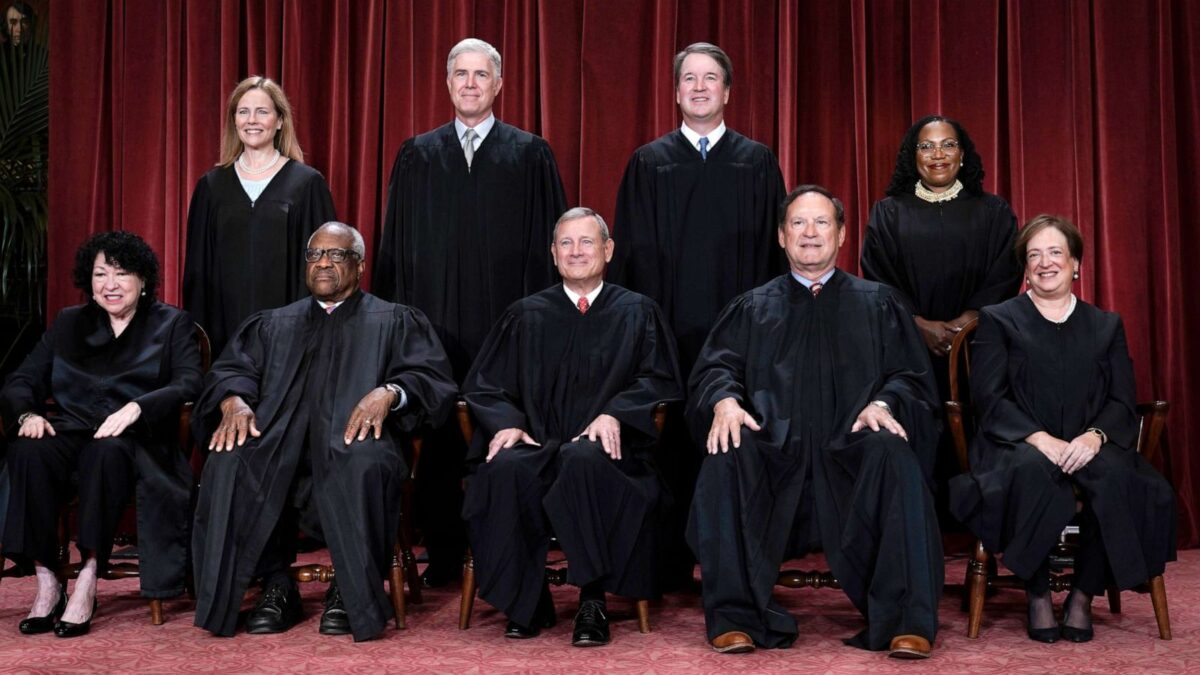

President Trump scored a last-minute legal victory Friday when Chief Justice John Roberts temporarily blocked a lower-court order that threatened to bring above-ground construction on the White House ballroom project to a screeching halt.
The emergency order allows construction to continue while the Supreme Court considers the Trump administration’s request for further intervention in the rapidly escalating legal battle.
And the timing wasn’t exactly leisurely.
Roberts acted shortly before a lower-court deadline that would have required above-ground construction to stop by the end of Friday.
The chief justice did not provide an explanation for issuing the temporary stay, and the order does not necessarily indicate how Roberts or the full Supreme Court will ultimately decide the dispute. Because Roberts handles emergency applications originating from Washington, D.C., the matter initially landed on his desk. He can also refer the administration’s request to the full court.
For now, however, the construction crews can keep working.
https://twitter.com/nicksortor/status/2090866000010805446
The dispute involves President Trump’s approximately 90,000-square-foot ballroom project at the White House, which has been challenged in court by the National Trust for Historic Preservation.
The preservation organization argues that the administration lacks sufficient congressional authorization to undertake such a significant alteration of the White House grounds.
“If Petitioners believe there is a pressing need for a ballroom, nothing prevents them from asking Congress for one — today, tomorrow, or any time in the future,” attorneys for the organization wrote in court filings. “But Petitioners’ efforts to foil judicial review and arrogate Congress’s exclusive powers should not be rewarded.”
The Trump administration sees the matter very differently.
Government attorneys argue that the project has received the necessary approvals and is being funded privately rather than through traditional congressional appropriations.
The Justice Department has also emphasized that the ballroom construction is tied to a broader security project involving the White House complex.
According to the administration, the work includes secure facilities intended to protect President Trump, senior government officials and White House guests amid heightened security concerns. Lower courts had permitted underground military-related construction to continue while ordering the above-ground ballroom work halted.
The administration argues that separating the projects isn’t as simple as opponents suggest and that stopping construction could interfere with sensitive security work.
There is also a potentially significant legal-standing question.
Solicitor General D. John Sauer has challenged whether the National Trust for Historic Preservation has the legal right to bring the lawsuit at all.
Sauer warned that accepting the group’s theory of standing could dramatically expand the universe of people capable of suing the federal government whenever they dislike changes to government property.
He argued that such a standard “would open the courthouse doors to any of the millions of people who visit government buildings, historic sites, or parks and happen to think that they dislike something they see.”
That’s a legal question extending well beyond chandeliers, banquet tables and whatever color carpet eventually ends up inside the ballroom.
The larger dispute concerns the boundaries between presidential authority, congressional power and judicial oversight when substantial changes are made to the White House complex.
Opponents argue Congress must have a greater role in approving major alterations to such an historically significant federal property. The administration maintains that the executive branch possesses broad authority over federal property under its control and that the privately financed project has satisfied applicable requirements.
Roberts’ order does not resolve any of those questions.
It simply prevents the lower-court restriction from taking immediate effect while the Supreme Court considers what comes next.
The justices could extend the stay, allow the lower-court order to take effect or take additional action after considering the administration’s arguments and the preservation group’s response.
So President Trump hasn’t won the entire ballroom case.
But when construction was facing a Friday deadline, his administration got exactly what it needed from the Supreme Court: more time and permission to keep building.
For a project measured in roughly 90,000 square feet, that’s no small victory.

Leave a Comment