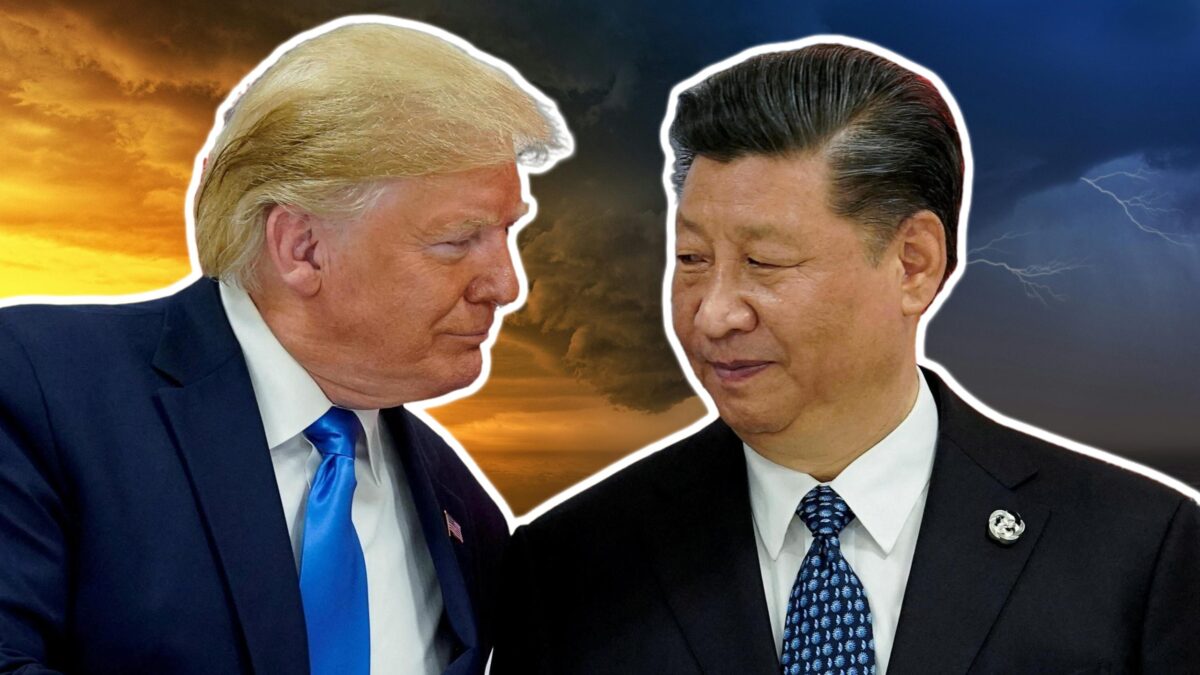

President Trump is heading to China with a delegation that looks less like a standard diplomatic trip and more like the guest list for a global billionaire summit. On Monday night, Trump revealed that some of the most powerful executives in America are accompanying him for meetings with Chinese President Xi Jinping and leaders of the Chinese Communist Party.
And naturally, the media immediately managed to get part of the story wrong.
Trump blasted CNBC after the network reported Nvidia CEO Jensen Huang was not invited on the trip. According to President Trump, Huang was literally sitting on Air Force One while the story circulated. Tough break for the “anonymous sources” crowd.
“CNBC incorrectly reported that the Great Jensen Huang, of Nvidia, was not invited,” Trump posted. “In actuality, Jensen is currently on Air Force One and, unless I ask him to leave, which is highly unlikely, CNBC’s reporting is incorrect or, as they say in politics, FAKE NEWS!”
Classic Trump. Equal parts press release and stand-up routine.
The president also outlined the massive roster of executives joining him, including Tesla CEO Elon Musk, BlackRock CEO Larry Fink, Apple CEO Tim Cook, Blackstone CEO Stephen Schwarzman, Boeing CEO Kelly Ortberg, Goldman Sachs CEO David Solomon, Qualcomm CEO Cristiano Amon, and several others representing America’s most influential industries.
It is a remarkable scene when you stop and think about it. The president of the United States traveling to China with leaders from technology, finance, aerospace, banking, manufacturing, and artificial intelligence sectors all on the same plane. Somewhere in Washington, a career bureaucrat probably fainted at the idea of actual business leaders being involved in economic diplomacy.
Trump framed the trip as an effort to push China toward opening its economy further to American businesses.
“I will be asking President Xi, a Leader of extraordinary distinction, to ‘open up’ China so that these brilliant people can work their magic,” Trump wrote.
That wording alone probably caused half the foreign policy establishment to start stress-eating kale chips. Trump has never approached international politics like a traditional politician. He approaches it like a businessman negotiating a giant deal, because, well, that’s exactly what he spent decades doing before entering politics.
The presence of Elon Musk adds another layer of intrigue to the trip. Musk’s business empire already has deep ties to China through Tesla manufacturing operations, while companies like Nvidia and Qualcomm are heavily tied to semiconductor and AI competition involving Beijing.
Then there’s Tim Cook, who has spent years navigating the delicate balancing act between Apple’s dependence on Chinese manufacturing and Washington’s increasingly aggressive stance toward China. Cook reportedly plans to step down as Apple CEO later this year after overseeing one of the most financially successful runs in corporate history.
Critics will undoubtedly complain about corporate executives accompanying President Trump overseas, but this trip highlights something many Americans have noticed for years. Economic strength and national power are deeply connected. Trade, manufacturing, technology, and supply chains are no longer side issues in foreign policy. They are foreign policy.
And whether his critics like it or not, President Trump understands that instinctively.
Leave a Comment