
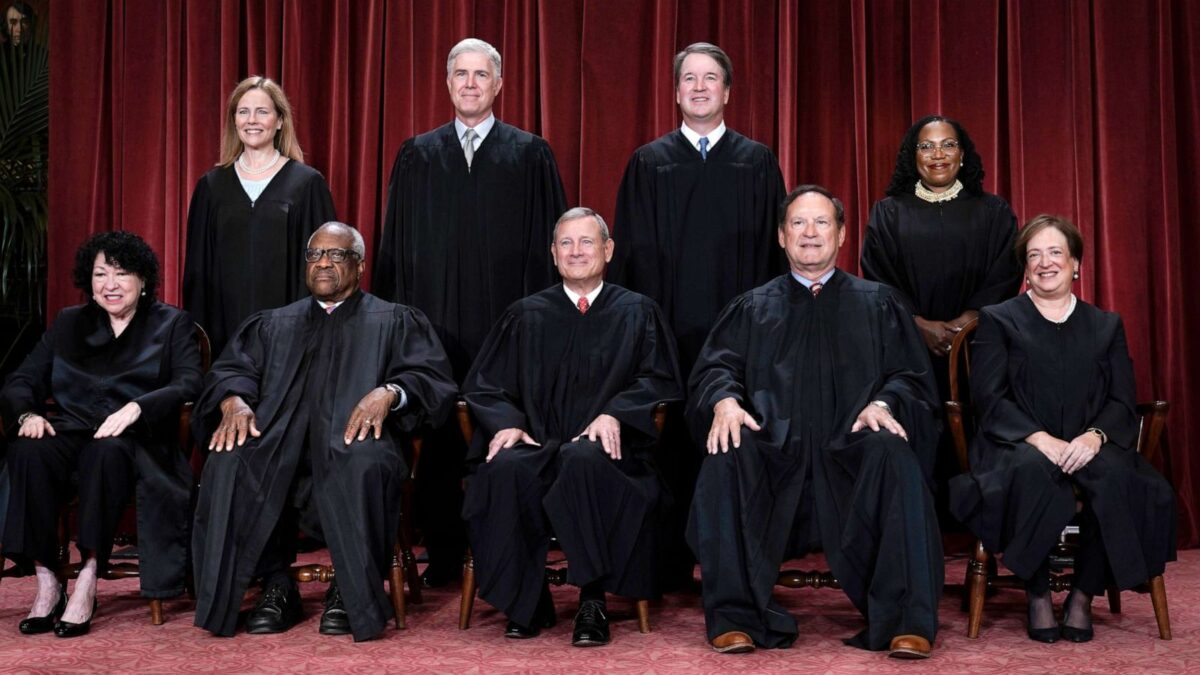

President Trump unloaded on two of his own Supreme Court appointees Sunday night after the high court struck down his administration’s emergency tariff authority, delivering one of his sharpest public rebukes yet against Justices Neil Gorsuch and Amy Coney Barrett.
In a lengthy 545-word Truth Social post, President Trump accused the pair of siding against both him and the country in a decision he described as economically disastrous. The ruling, handed down in late February, found that Trump’s use of the International Emergency Economic Powers Act to impose tariffs exceeded constitutional limits. Gorsuch and Barrett joined Chief Justice John Roberts and the court’s liberal wing in the 6-3 majority.
The dissent came from Justices Clarence Thomas, Samuel Alito, and Brett Kavanaugh.
Trump made clear he viewed the outcome as more than a legal disagreement. To him, it represented another example of Republican-appointed judges bending over backward to prove their “independence” while Democrats remain politically aligned with the administrations that appointed them.
“I don’t want loyalty, but I do want and expect it for our Country,” President Trump wrote. He argued that while he technically still has alternative methods to impose tariffs, the process is slower and more burdensome than the emergency powers route the court rejected.
Trump also warned the ruling could cost the United States an estimated $159 billion if companies and foreign entities seek repayment of tariffs already collected under the now-invalidated authority. Naturally, that possibility did not exactly improve his mood.
“They were appointed by me, and yet have hurt our Country so badly!” Trump wrote about Gorsuch and Barrett. He insisted he still respects both justices personally, especially Gorsuch, whom he called “really smart and good,” but argued their decision inflicted severe damage on American economic interests.
The president also tied the tariff case directly to another looming Supreme Court battle, birthright citizenship. Trump predicted the court may soon rule against his administration’s efforts to limit automatic citizenship for children born in the U.S. to non-citizen parents engaged in what he calls “birth tourism.”
Trump argued such a ruling would leave America uniquely vulnerable and financially strained. He claimed the current interpretation of birthright citizenship is “unsustainable, unsafe, and incredibly costly,” while expressing frustration that the Supreme Court did not even acknowledge his attendance during a recent session. Apparently even the seating arrangements at the court are now part of the broader constitutional crisis.
Perhaps the most eyebrow-raising moment came when Trump flirted with the idea of court packing, a proposal long associated with progressive Democrats. Mocking the concept, Trump argued that because some Republican-appointed justices repeatedly rule against conservative priorities, Democrats no longer need to expand the court.
“In fact, I should be the one wanting to PACK THE COURT!” Trump wrote.
That line alone probably caused several constitutional law professors to spill coffee onto expensive tweed jackets Monday morning.
Still, the larger frustration from President Trump reflects a sentiment widely shared among many conservatives. Republican voters often expect GOP-appointed judges to interpret the Constitution through an originalist lens, particularly on issues involving executive authority, immigration, and national sovereignty. When those justices side with liberal colleagues in major cases, it fuels accusations that Republican nominees are more concerned with elite institutional approval than the policy goals that helped elevate them to the bench.
The Supreme Court, of course, insists it operates independently from partisan politics. But in modern America, every major ruling instantly becomes political whether the justices like it or not. And when billions of dollars, border policy, and presidential authority are all on the line, nobody in Washington is pretending these fights are merely academic exercises anymore.
Leave a Comment