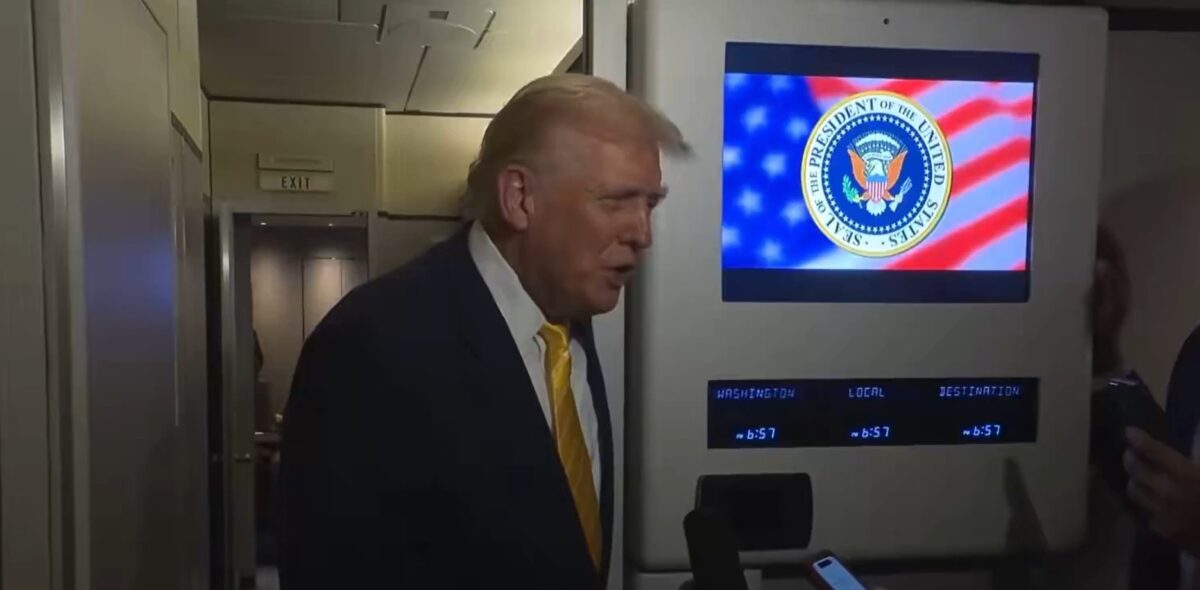

President Trump is declaring the Iran war over, and predictably Washington has responded the only way it knows how, by launching a new war over paperwork. In a letter to Congress obtained by POLITICO, the White House argued that hostilities with Iran have “terminated,” citing an ongoing ceasefire and no exchange of fire since April 7, 2026. That announcement comes just as the 60-day War Powers Resolution deadline arrives, which means Capitol Hill suddenly remembers it has constitutional opinions.
Trump’s letter was direct. “The hostilities that began on February 28, 2026, have terminated.” That is not the kind of sentence that leaves much room for interpretation, unless you work in Congress, where clear language is often treated like an optional suggestion.
The administration’s argument is simple: if the fighting has stopped, then the legal countdown requiring congressional approval for continued military action no longer applies. Defense Secretary Pete Hegseth reinforced that position, telling senators the ceasefire means the 60-day clock “pauses, or stops.” Critics immediately reacted as if the Magna Carta had been set on fire.
The War Powers Resolution, passed in 1973 after the Vietnam era, requires presidents to seek congressional authorization within 60 days of introducing forces into hostilities, with a possible 30-day withdrawal period. Like many Washington laws, it sounds tidy on paper and becomes messy the moment reality arrives.
Sen. Susan Collins became the first Republican to publicly object, saying the deadline “is not a suggestion; it is a requirement.” Fair enough. Congress wrote the law. Congress also has a habit of avoiding hard votes, then complaining when presidents act. That bipartisan tradition deserves a museum wing.
Opponents of the administration note that roughly 50,000 U.S. troops remain stationed across the region and that a naval blockade of Iranian ports reportedly continues. They argue that even without active exchanges of fire, military involvement has not truly ended. That is a serious point and one worthy of debate.
But there is another serious point: presidents of both parties have stretched, ignored, sidestepped, or reinterpreted the War Powers Resolution for decades. Trump was not wrong when he noted that many previous presidents exceeded the timeline. Suddenly pretending this is an unprecedented constitutional crisis requires a very selective memory.
Trump also said critics are overstepping and called some of them unpatriotic, which is vintage Trump, subtle as a marching band in a library. Yet beneath the rhetoric lies a real issue: who decides when America is at war, and who decides when it is over?
If the ceasefire holds, the public will care less about legal theories than results. No missiles flying, no new casualties, and no wider regional disaster tend to focus minds quickly.
Congress is free to debate. That is its job. But if peace has been achieved, many Americans will wonder why lawmakers seem more energized by procedure than by the end of hostilities.
In Washington, sadly, that question answers itself.
Leave a Comment