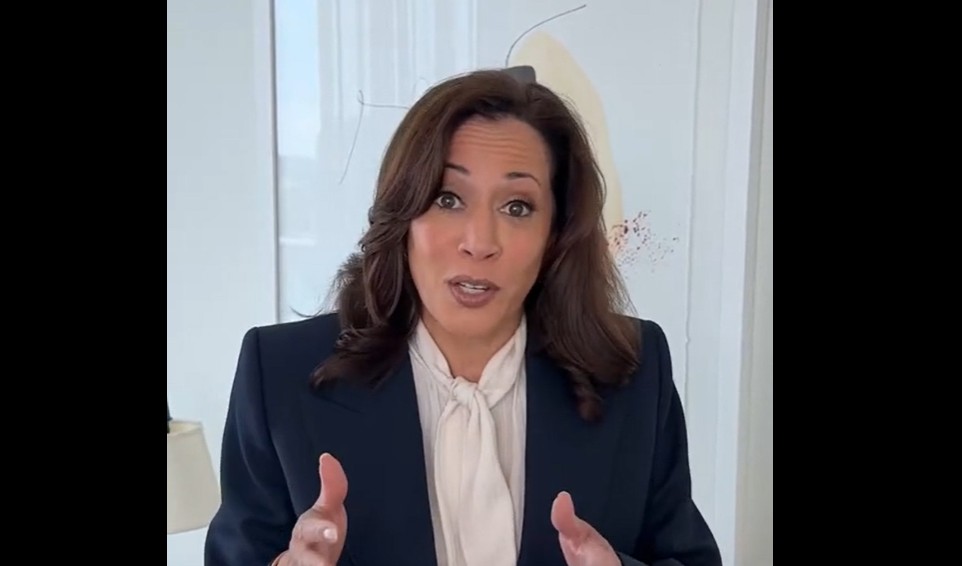

Kamala Harris jumped back into the national political conversation this weekend with a warning about voting rights, taking aim at the Supreme Court, President Trump and proposed federal legislation requiring documentary proof of citizenship for voter registration.
In a video circulated online, Harris argued that Americans are facing new obstacles to voting and specifically criticized the SAVE America Act.
“Hey everybody, so they’re trying to mess with your ability to vote, just to break it all down,” Harris said before criticizing a recent Supreme Court decision involving the Voting Rights Act.
Harris then turned to the proposed citizenship requirements.
“So you got the Supreme Court doing its thing. Then this president is trying to push this SAVE Act, which basically would require that for people to register to vote,” Harris said. “You’re going to have to have proof of who you are… through a passport, which a lot of Americans don’t have, or a birth certificate. Same point, obstacles to make it difficult for you to register to vote.”
These are challenging times, but we are not powerless.
If our votes did not matter, they would not be working overtime to make them harder to cast.
This November, we will show them what happens when millions of Americans turn out in our numbers. pic.twitter.com/nsftER5T90
— Kamala Harris (@KamalaHarris) August 7, 2026
The political argument is straightforward. Harris and other opponents contend that documentary requirements could make registration more burdensome for eligible Americans who do not readily possess certain documents.
Supporters see the issue very differently.
They argue that requiring proof of citizenship is a basic election-security measure, particularly because voting in federal elections is reserved for U.S. citizens. Under the legislation described in reports about the proposal, acceptable documentation would not necessarily be limited to passports and birth certificates. Other qualifying documentation could include certain REAL ID-compliant identification and military identification.
That distinction quickly became part of the criticism directed at Harris after her remarks circulated online.
The broader political problem for opponents of the legislation is that proof-of-citizenship requirements appear to have substantial public support.
According to a Rasmussen Reports survey cited by The Washington Times, 62 percent of likely voters supported the SAVE America Act, compared with 33 percent who opposed it.
That does not settle the policy debate, of course, but politicians generally prefer arguing from the 62 percent side of a poll rather than explaining why the 62 percent is wrong.
The controversy also arrives as Harris’ previous comments about election security are being recirculated by critics.
In 2019, while running for president, Harris advocated replacing voting machines with paper ballots, a position supporters framed at the time around election security concerns. Critics now point to those remarks while accusing her of applying different standards to contemporary Republican-backed election proposals.
The two issues are not identical. Paper ballots concern how votes are cast and recorded, while proof-of-citizenship requirements concern eligibility and voter registration. Still, the old comments provide Republicans with an obvious political opening: If additional safeguards were worth discussing when Harris was worried about voting technology, why should documentation requirements automatically be characterized as an attack on voting rights?
That is the argument likely to follow the SAVE America Act as Congress debates its future.
There are also practical questions lawmakers cannot simply ignore. Any federal documentation requirement would need procedures ensuring eligible citizens who lack readily available paperwork have a reasonable way to establish citizenship. Election security and ballot access do not have to be treated as mutually exclusive goals.
But Harris’ weekend remarks demonstrate how sharply divided Washington remains over even that premise.
Republicans increasingly frame proof of citizenship as a common-sense prerequisite for federal voter registration. Democrats warn that documentation requirements could disenfranchise legitimate voters.
The public will ultimately judge which argument is more convincing.
For Harris, however, attacking a proposal that polling indicates enjoys broad support carries an obvious political risk. After losing the presidency, she is once again stepping into a national debate where Republicans are more than happy to make election integrity the subject.
And judging by the reaction to her latest video, that debate is not going away anytime soon.
Leave a Comment